
Introduction
Efficient extraction of large quantities of high-quality genomic DNA is a major bottleneck in plant molecular genetics and agricultural genomics. Many downstream applications such as mutation discovery, genotyping, and large-scale population screening depend on DNA that is both abundant and consistently pure across thousands of samples.
One important application is TILLING (Targeting Induced Local Lesions IN Genomes), a reverse genetics approach used to identify mutations in genes with known sequences. TILLING requires DNA from very large plant populations, often involving thousands of individual lines. For this approach to work effectively, DNA must meet two key requirements:
- High yield from each individual sample
- Consistent quality across all samples to allow accurate pooling
However, existing plant DNA extraction methods present important limitations. Many high-throughput protocols either produce insufficient DNA quantities or generate variable quality DNA that is not suitable for large-scale pooling and analysis. Commercial DNA extraction kits can improve quality, but they often:
- Produce relatively low DNA yields
- Require expensive reagents
- Increase overall project cost, especially for small laboratories
To address these challenges, we describe a low-cost, high-throughput, and high-efficiency genomic DNA extraction method designed for plant tissues, particularly sorghum leaves and dry seeds. The method combines:
- A standard CTAB-based extraction system
- A simplified chloroform purification step
- A modified magnetic bead-based DNA cleanup using silica-coated beads
This integrated workflow significantly reduces reagent cost while improving both DNA yield and quality. The method was also validated across multiple plant species to demonstrate its broad applicability.
Plant Materials Used
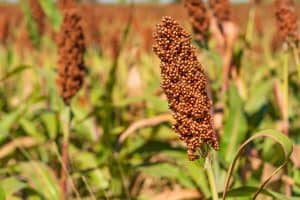
The primary biological material used for protocol development was sorghum (Sorghum bicolor L. Moench cv. BTx623) grown under field conditions at USDA-ARS experimental sites in Lubbock, Texas.
Sample Collection
- Leaf tissue: 5–20 cm² sections (approximately 0.1–0.4 g fresh weight)
- Seeds: 8–12 dry seeds per sample
- Samples were collected in labeled 2 mL microcentrifuge tubes
- Field samples were immediately stored on ice
- Leaf tissues were freeze-dried for 48 hours before DNA extraction
After lyophilization, samples were either processed immediately or stored at room temperature in the dark for up to three months without noticeable DNA degradation.
Cross-Species Validation
To evaluate the robustness of the method, additional plant species were tested, including:
- Bermuda grass (Cynodon dactylon)
- Poplar (Populus deltoides)
- Afghan pine (Pinus eldarica)
- Wheat (Triticum aestivum)
- Maize (Zea mays)
- Cotton (Gossypium hirsutum)
- Tobacco (Nicotiana tabacum)
Samples included leaves, needles, and seedlings collected from field and greenhouse conditions. These species were chosen due to differences in genome size and biochemical composition, including polysaccharides and phenolic compounds that typically interfere with DNA extraction.
DNA yield was calculated based on dry tissue weight and expressed as:
micrograms of DNA per milligram of dry plant material
Reagents and Key Consumables
The protocol uses standard molecular biology reagents combined with magnetic bead purification:
- CTAB (cetyltrimethylammonium bromide)
- Magnetic bead DNA purification system (MagAttract-based system)
- Ethanol (molecular biology grade)
- RNase A
- Chloroform:isoamyl alcohol (24:1)
- Tungsten grinding beads
- 96-well plates and sealing mats
- Standard microcentrifuge tubes
Buffer Systems Used
The method relies on optimized buffer chemistry to improve DNA precipitation and purity:
CTAB Extraction Buffer
- Tris-HCl (100 mM, pH 8.0)
- EDTA (20 mM)
- CTAB (2%)
- NaCl (1.2 M)
- β-mercaptoethanol (0.1%, added fresh)
Dilution Buffer
- Tris-HCl (100 mM, pH 8.0)
- EDTA (20 mM)
- CTAB (2%)
High-Salt TE Buffer
- Tris-HCl (10 mM, pH 8.0)
- EDTA (2 mM)
- NaCl (1 M)
- RNase A (50 µg/mL)
Wash Buffer
- 70% ethanol in TE buffer
Equipment Used
The workflow is designed for scalability and includes standard laboratory equipment:
- Freeze dryer (lyophilizer)
- Tissue grinding system (bead-based homogenizer)
- Centrifuge compatible with 96-well plates
- Magnetic separation rack
- Multichannel pipettes
- Heating block (60°C)
- Spectrophotometer (Nanodrop or plate reader system)
DNA Extraction Protocol
The method is optimized for high-throughput processing using a 96-well format and consists of the following key steps:
1. Tissue Grinding
- Lyophilized plant tissue (10–40 mg) or dry seeds are placed in 2 mL tubes
- A tungsten bead is added for mechanical disruption
- Samples are homogenized using a bead mill system
- Multiple grinding cycles ensure uniform tissue disruption
2. CTAB-Based Cell Lysis
- CTAB extraction buffer is added to ground tissue
- Samples are incubated at 60°C for 1 hour
- This step breaks down cell walls and releases nucleic acids
3. Chloroform Extraction
- Chloroform:isoamyl alcohol is added to remove proteins, lipids, and polysaccharides
- Phase separation is achieved by centrifugation
- The aqueous phase containing DNA is carefully collected
4. DNA Precipitation and CTAB Complex Formation
- A dilution buffer is added to reduce salt concentration
- DNA forms a visible CTAB-DNA precipitate
- This improves DNA recovery efficiency and consistency
5. Washing and Purification
- The DNA pellet is washed with ethanol-based buffer
- Excess CTAB and contaminants are removed
- DNA is resuspended in high-salt TE buffer with RNase treatment
6. Magnetic Bead Cleanup
- DNA is transferred to 96-well plates
- Magnetic beads and ethanol are added to bind DNA
- DNA binds to silica-coated beads under high-salt conditions
- Multiple wash steps remove impurities
- DNA is eluted in TE buffer after magnetic separation
7. Quantification
- DNA concentration and purity are measured using:
- Nanodrop spectrophotometer
- Or microplate reader system
Results and Performance Summary
The developed method provides significant improvements over standard commercial kits:
DNA Yield Improvement
- Approximately 30-fold increase in DNA yield compared to commercial kits
- Up to 4.7 µg DNA per mg dry tissue in high-yield species
- Successful extraction from both leaves and dry seeds
DNA Quality
- High purity confirmed by absorbance ratios:
- OD260/OD280: ~1.8–2.0
- OD260/OD230: >2.0
- High molecular weight DNA (>20 kb) obtained
- DNA is fully digestible with restriction enzymes
Cross-Species Performance
- Effective across grasses, crops, trees, and gymnosperms
- High consistency across species with varying secondary metabolites
- Slight yield variation depending on genome size and tissue type
Method Advantages
This improved DNA extraction system offers several important advantages:
- High throughput compatibility (96-well format)
- Low reagent cost due to reduced magnetic bead usage
- High DNA yield from both fresh and dried tissues
- Stable DNA quality across large sample sets
- Works on difficult plant species rich in polysaccharides and phenolics
- No need for liquid nitrogen grinding in routine workflow
- Suitable for large-scale genotyping and TILLING studies
Discussion
The success of this method is based on three key improvements over conventional CTAB or commercial kit workflows:
1. Chloroform Purification Step
Improves separation efficiency and increases recovery of clean aqueous DNA phase while removing contaminants such as lipids and polysaccharides.
2. Optimized CTAB Precipitation
Reducing NaCl concentration enhances consistent formation of CTAB-DNA complexes, improving yield stability across different tissue types.
3. Improved Magnetic Bead Cleanup
DNA binding and elution efficiency are increased under optimized salt and ethanol conditions. This allows:
- Lower bead usage
- Reduced cost per sample
- High-quality DNA recovery with minimal contaminants
Scalability and Throughput
The method is fully scalable:
- Single-tube format for small experiments
- 96-well plate format for large-scale genomic studies
- One technician can process multiple 96-well plates per day
- Compatible with automated or semi-automated workflows
Conclusion
This high-throughput plant DNA extraction method provides a robust solution for large-scale genomic studies. It delivers:
- High DNA yield
- High and consistent DNA quality
- Low operational cost
- Broad applicability across plant species
The method is especially suitable for applications requiring large DNA collections such as TILLING, population genomics, and plant breeding programs. Its simplicity, scalability, and cost efficiency make it a practical alternative to commercial DNA extraction kits for both research laboratories and high-throughput genomics facilities.