
Introduction to Clinical Metagenomic Next-Generation Sequencing
Clinical metagenomic next-generation sequencing (mNGS) has transformed the field of infectious disease diagnostics by enabling comprehensive and unbiased pathogen detection directly from patient samples. Next-generation sequencing (NGS), also known as high-throughput sequencing or massively parallel sequencing, refers to a group of advanced molecular technologies capable of simultaneously sequencing millions to billions of DNA or RNA fragments in a single experiment. This revolutionary approach provides clinicians and researchers with the ability to identify a wide spectrum of microorganisms rapidly and accurately.
Unlike conventional microbiological techniques that target only predefined organisms, metagenomic NGS uses an untargeted shotgun sequencing strategy. In this method, all nucleic acids present in a clinical specimen are analyzed collectively without prior assumptions regarding the infectious agent. As a result, mNGS can detect bacteria, viruses, fungi, and parasites in a single assay, including rare, unexpected, or newly emerging pathogens.
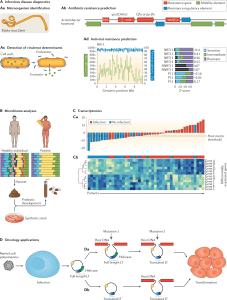
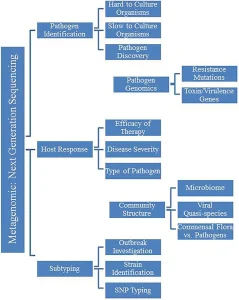
Clinical applications of mNGS include direct pathogen identification from cerebrospinal fluid, blood, respiratory samples, tissues, stool, ocular fluids, and other biological specimens. In addition to infectious disease diagnosis, NGS technologies are also widely used in microbial epidemiology, drug resistance analysis, microbiome research, strain typing, and outbreak tracking.
Traditional diagnostic approaches such as microbial culture, antigen testing, and polymerase chain reaction (PCR) remain valuable; however, they are often limited by low sensitivity, long turnaround times, or the requirement for prior knowledge of the suspected pathogen. In contrast, mNGS provides a hypothesis-free diagnostic strategy capable of identifying virtually any microorganism present in the sample.
Major Next-Generation Sequencing Platforms
Illumina Sequencing Technology
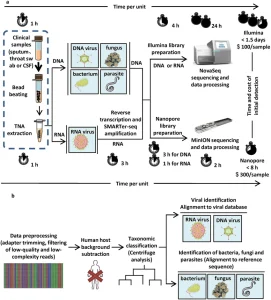
Illumina sequencing platforms are among the most commonly used systems in clinical metagenomics. Popular instruments include iSeq, MiSeq, MiniSeq, NextSeq, HiSeq, and NovaSeq. These systems rely on bridge amplification and sequencing-by-synthesis chemistry.
During sequencing, DNA fragments are attached to a flow cell and amplified locally to generate clusters of identical DNA molecules. Fluorescently labeled nucleotides are then incorporated one base at a time, and optical imaging determines the sequence of each fragment.
Illumina technology offers extremely high sequencing throughput and excellent accuracy, making it suitable for large-scale pathogen detection studies. However, one known limitation is barcode index switching, also called index hopping, which may cause cross-contamination between multiplexed samples and generate false-positive microbial detections.
Ion Torrent Sequencing
The Ion Torrent platform developed by Thermo Fisher Scientific uses semiconductor sequencing technology. DNA fragments are amplified on microscopic beads within emulsion droplets and subsequently loaded onto a chip containing pH sensors.
As nucleotides are incorporated during sequencing, hydrogen ions are released, producing measurable pH changes that identify each nucleotide. Ion Torrent systems provide relatively rapid sequencing and are commonly used for targeted sequencing applications and microbial analysis.
BGISEQ Technology
BGI developed the BGISEQ platform using DNA nanoball and DNA origami technology. Single DNA molecules are amplified into compact nanoballs on a flow cell and sequenced using fluorescent sequencing-by-synthesis chemistry.
This platform has demonstrated utility in infectious disease diagnostics and metagenomic sequencing studies. BGISEQ technology offers high data output and competitive sequencing performance for pathogen detection workflows.
Oxford Nanopore Sequencing
Oxford Nanopore Technologies introduced portable sequencing devices such as MinION, GridION, and PromethION. Nanopore sequencing differs fundamentally from sequence-by-synthesis technologies.
Single-stranded DNA or RNA molecules pass through protein nanopores embedded in a membrane. Changes in electrical current generated during translocation are analyzed to determine nucleotide sequences in real time.
Nanopore sequencing offers several advantages:
- Ultra-fast sequencing speed
- Real-time data generation
- Long-read sequencing capability
- Portable instrumentation
- Minimal sample preparation requirements
However, current limitations include higher sequencing error rates, lower throughput compared with Illumina systems, and higher per-read costs for certain applications.
Advantages of Metagenomic NGS in Infectious Disease Diagnosis
Broad and Unbiased Pathogen Detection
One of the most important advantages of mNGS is its unbiased analytical capability. Since no organism-specific primers or probes are required, the technology can identify known pathogens, rare organisms, co-infections, and even novel infectious agents.
This broad detection spectrum is particularly valuable in critically ill or immunocompromised patients where conventional testing frequently fails to establish an etiological diagnosis.
Simultaneous Detection of Multiple Microorganisms
Clinical mNGS can detect bacteria, viruses, fungi, and parasites simultaneously within the same sample. This is highly beneficial for polymicrobial infections and complex clinical presentations.
Unlike targeted PCR assays that require multiple individual tests, mNGS consolidates pathogen detection into a single comprehensive workflow.
Detection of Rare and Emerging Pathogens
mNGS has proven particularly useful for identifying unusual pathogens that may not be included in routine diagnostic panels. This includes emerging viruses, opportunistic fungi, uncommon parasites, and antimicrobial-resistant organisms.
The technology has also contributed significantly to outbreak investigations and epidemiological surveillance.
Quantitative and Genomic Information
Sequencing read counts generated during mNGS analysis can provide semiquantitative estimates of microbial abundance. This information may help distinguish colonization from active infection.
Additionally, genomic data obtained through sequencing can support:
- Strain identification
- Antimicrobial resistance prediction
- Virulence factor characterization
- Evolutionary and phylogenetic analyses
- Transmission tracking
Limitations of Metagenomic NGS
Dominance of Human Host DNA
A major technical challenge in clinical metagenomics is the overwhelming presence of human nucleic acids in patient samples. In many specimens, over 99% of sequencing reads originate from the human host rather than microorganisms.
This significantly reduces analytical sensitivity for pathogen detection because microbial reads become extremely rare within the sequencing dataset.
Host Depletion Strategies
To improve microbial detection sensitivity, several host depletion techniques have been developed.
Targeted Sequencing Approaches
Targeted amplification of conserved microbial genes such as 16S ribosomal RNA for bacteria or internal transcribed spacer regions for fungi enriches pathogen sequences while minimizing human background reads.
Human RNA and DNA Removal
Host depletion methods may include:
- Selective lysis of human cells
- DNase treatment
- RNase H depletion
- CRISPR-Cas9–based depletion
- Hybridization capture probes
- Cell-free nucleic acid enrichment
These approaches increase the proportion of microbial sequences and improve overall assay sensitivity.
Contamination Challenges
Because mNGS is extremely sensitive, contamination represents a major concern. Potential contamination sources include:
- Laboratory reagents
- Environmental microbes
- Skin flora
- Cross-sample contamination
- Barcode index hopping
Strict laboratory quality control procedures and negative controls are essential to minimize false-positive detections.
Clinical mNGS Workflow
Sample Collection and Transport
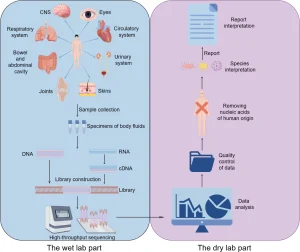
Clinical metagenomic sequencing can be performed using numerous specimen types, including:
- Blood
- Cerebrospinal fluid
- Bronchoalveolar lavage
- Tissue biopsies
- Stool
- Swabs
- Ocular fluids
- Environmental samples
Proper sample handling is critical to preserve nucleic acid integrity, especially for RNA sequencing applications where degradation can occur rapidly.
Nucleic Acid Extraction
DNA and RNA extraction protocols vary according to specimen type and intended sequencing strategy. Efficient extraction is essential to maximize microbial nucleic acid recovery while minimizing inhibitors and contaminants.
Both manual and automated extraction systems are commonly used in clinical laboratories.
Library Preparation
Library preparation converts extracted nucleic acids into sequencing-compatible fragments by adding sequencing adapters and amplification indices.
Shotgun metagenomic sequencing typically uses either:
- Tagmentation-based library preparation
- Adapter ligation after DNA fragmentation
RNA sequencing usually requires reverse transcription into complementary DNA before sequencing library generation.
Bioinformatics Analysis
After sequencing, computational analysis pipelines process the raw data through multiple steps:
- Quality filtering and adapter trimming
- Human read subtraction
- Alignment to microbial reference databases
- Taxonomic classification
- Statistical interpretation
- Data visualization and reporting
Common bioinformatics platforms include:
- SURPI
- Kraken
- Taxonomer
- Custom clinical pipelines
Reference databases such as GenBank play a critical role in organism identification accuracy.
Quality Assurance in Clinical mNGS
Internal and External Controls
Quality control measures are essential throughout the mNGS workflow. Laboratories typically use:
- Internal spike-in controls
- Positive controls
- Negative controls
- Extraction controls
- Sequencing controls
These controls help monitor assay sensitivity, contamination, extraction efficiency, and sequencing performance.
Contamination Monitoring
Routine contamination surveillance includes:
- Reagent testing
- Workflow separation
- Environmental monitoring
- Negative control sequencing
- Barcode contamination assessment
Maintaining strict contamination control is particularly important due to the high sensitivity of metagenomic sequencing assays.
Bioinformatics Quality Control
Bioinformatics pipelines require rigorous version control and validation procedures. Key quality metrics include:
- Read depth
- Sequence quality
- Complexity scores
- Host subtraction efficiency
- Taxonomic assignment accuracy
Continuous database updates are also necessary to improve pathogen detection sensitivity.
Clinical Applications of Metagenomic Sequencing
Central Nervous System Infections
mNGS has shown exceptional utility in diagnosing meningitis and encephalitis when conventional testing fails. Cerebrospinal fluid sequencing has successfully identified:
- Viral infections
- Bacterial meningitis
- Fungal encephalitis
- Parasitic infections
This approach enables minimally invasive diagnosis of complex neurological infections.
Bloodstream Infections and Sepsis
Sequencing of plasma cell-free DNA and RNA can detect bloodstream pathogens even in patients receiving antimicrobial therapy.
mNGS may improve diagnosis of culture-negative sepsis and severe systemic infections.
Respiratory Tract Infections
Respiratory samples frequently contain mixed microbial populations. mNGS can identify causative pathogens in pneumonia and other pulmonary infections while simultaneously characterizing microbial communities.
Gastrointestinal Infections
Metagenomic sequencing of stool and gastrointestinal samples allows identification of bacterial, viral, and parasitic pathogens associated with diarrhea and inflammatory diseases.
The technology can also detect antimicrobial resistance genes.
Ocular Infections
mNGS has demonstrated utility for diagnosing difficult intraocular infections from limited-volume eye specimens, expanding diagnostic capabilities beyond conventional testing.
Validation of Clinical mNGS Assays
Validation of metagenomic sequencing assays includes both wet-laboratory and bioinformatics components.
Key validation parameters include:
- Accuracy
- Precision
- Reproducibility
- Sensitivity
- Specificity
- Limit of detection
- Contamination assessment
- Stability testing
Representative organisms from multiple pathogen groups are commonly used during assay validation.
Future Perspectives of Metagenomic Sequencing
Clinical metagenomic next-generation sequencing represents a major advancement in infectious disease diagnostics. Ongoing improvements in sequencing chemistry, bioinformatics, database quality, contamination control, and cost reduction are expected to further enhance clinical utility.
As sequencing becomes faster, more affordable, and more standardized, mNGS is likely to become an increasingly important tool in precision medicine, hospital microbiology, outbreak surveillance, and global infectious disease management.
Conclusion
Metagenomic next-generation sequencing has revolutionized pathogen detection by providing an unbiased, comprehensive, and highly sensitive diagnostic platform capable of identifying a vast range of infectious agents directly from clinical samples.
Although challenges remain regarding contamination, host background interference, bioinformatics complexity, and standardization, mNGS continues to demonstrate remarkable potential in diagnosing complex infections that conventional methods often fail to identify.
The integration of advanced sequencing technologies into clinical microbiology laboratories is expected to significantly improve infectious disease diagnosis, patient management, antimicrobial stewardship, and epidemiological surveillance in the coming years.