
Background
Bacteria represent one of the most abundant life forms on Earth, with an estimated 4–6 × 10³⁰ prokaryotic cells inhabiting diverse environments. They play essential roles in ecosystems and human health, including digestion, disease processes, decomposition, and oxygen cycling. Understanding bacterial genetic diversity is therefore critical for explaining how microorganisms evolve and adapt to different ecological niches.
Recent advances in high-throughput sequencing technologies have dramatically increased access to bacterial genomic data. Modern sequencing platforms now generate large datasets quickly, at lower cost, and with turnaround times of only a few days. This rapid growth has expanded both clinical and research applications, significantly improving our understanding of microbial genetics.
However, maximizing the value of sequencing data requires optimized experimental and computational strategies. Sequencing platforms, DNA preparation methods, and bioinformatics pipelines all strongly influence the quality of genomic insights obtained. A key step in microbial genomics is accurate genome assembly, which reconstructs complete bacterial genomes from sequencing reads. Poor or fragmented assemblies can limit downstream analyses such as gene prediction, functional annotation, and phylogenetic studies, while high-quality assemblies enable deeper biological interpretation.
Sequencing Technologies and Assembly Challenges
Two widely used benchtop sequencing platforms dominate bacterial genomics today:
- Ion Torrent PGM
- Illumina MiSeq
Both systems generate short reads (typically 150–400 nucleotides) in either single-end or paired-end formats. Although cost-effective and fast, assembling bacterial genomes (several million base pairs) using short reads alone is computationally challenging. This approach is commonly referred to as short-read-only assembly, which often produces fragmented genomes.
In contrast, the Pacific Biosciences (PacBio) RS platform provides long-read sequencing, with reads reaching up to ~20 kb and average lengths of 4–5 kb. Unlike short-read technologies, PacBio sequences single DNA molecules without amplification, preserving native DNA structure. This enables not only genome sequencing but also direct detection of epigenetic modifications, such as DNA methylation.
Despite its advantages, PacBio sequencing has a higher per-base error rate compared to Illumina or Ion Torrent platforms. To address this limitation, hybrid approaches have been developed where high-accuracy short reads are used to correct long PacBio reads before assembly. These strategies are known as hybrid assemblies and are often performed using tools such as the Celera assembler.
More recently, self-correction approaches using PacBio-only data have been introduced, allowing long reads to be corrected by overlapping reads from the same dataset. These corrected reads can then be assembled directly, forming the basis of PacBio-only assembly pipelines.
Hybrid Scaffolding and Assembly Improvement Strategies
Another approach to improve existing bacterial genome assemblies is hybrid scaffolding, where long PacBio reads are used to connect previously assembled short-read contigs. These contigs are linked into scaffolds containing gaps (represented by Ns), which can later be filled using tools such as PBJelly. This method improves continuity and increases genome completeness.
However, while hybrid scaffolding improves assembly structure, it may introduce errors such as mismatches, insertions, deletions, and mis-joins due to incorrect contig linking.
Study Design and Objective
In this study, we analyzed the E. coli strain BL21(DE3), which has a well-characterized reference genome, alongside additional strains (Bal225 and DH5α). Each strain was sequenced using:
- Illumina MiSeq (short paired-end reads)
- Ion Torrent PGM (short single-end reads)
- PacBio RS (long reads)
We systematically evaluated four genome assembly strategies:
- Short-read-only assembly
- Hybrid scaffolding
- Hybrid assembly (short-read error correction of long reads)
- PacBio-only assembly (self-corrected long reads)
The goal was to identify the most accurate and complete assembly approach for bacterial genomes under different sequencing conditions.
Methylome and Base Modification Analysis
Beyond genome assembly, we also investigated DNA methylation patterns using PacBio sequencing kinetics. PacBio technology detects base modifications by analyzing DNA polymerase behavior during sequencing. Variations in interpulse duration signal the presence of modified bases.
We focused on three key methylation systems in E. coli:
- DAM methylase (GATC motif, 6mA modification)
- DCM methylase (CCAGG and CCTGG motifs, 5mC modification)
- EcoKI methylase (complex recognition motifs involving adenine methylation)
Each bacterial strain was selected based on its known methyltransferase profile:
- DH5α: all methylases active
- BL21(DE3): lacks DCM and EcoKI systems
- Bal225: lacks DAM and DCM methylases
This allowed validation of PacBio’s ability to accurately detect expected methylation patterns.
Short-Read Assembly Performance
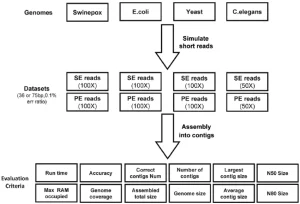
We first evaluated short-read assemblies using Velvet, Ray, and MIRA assemblers across multiple coverage depths (25×–100×). Performance varied significantly depending on both sequencing platform and assembler type.
- Velvet performed best with Illumina MiSeq data but failed with Ion Torrent reads due to error profile sensitivity.
- Ray produced the most balanced and accurate assemblies overall.
- MIRA performed best with Ion Torrent data but struggled with Illumina Nextera-derived libraries.
Assembly quality did not always improve with higher coverage, indicating diminishing returns and potential assembly artifacts at excessive depth.
Hybrid Scaffolding Results
Integrating PacBio long reads significantly improved short-read assemblies:
- Contig counts reduced by ~30–80%
- N50 values increased up to 10-fold
- Maximum contig lengths improved dramatically
Most improvements were achieved with ~25× PacBio coverage, suggesting diminishing returns beyond this threshold. However, hybrid scaffolding also introduced structural errors, including SNPs, indels, and mis-joins, highlighting a trade-off between completeness and accuracy.
Hybrid Assembly Performance
Hybrid assembly using error-corrected PacBio reads improved genome reconstruction further. Ion Torrent-corrected reads surprisingly outperformed MiSeq-corrected reads due to longer effective corrected read lengths.
Key findings:
- Assemblies achieved >99.9% identity to reference genomes
- Ion Torrent-based corrections produced more contiguous assemblies
- MiSeq-based corrections had lower indel rates but shorter contigs
PacBio-Only Assembly Performance
Self-corrected PacBio assemblies outperformed hybrid approaches in both accuracy and completeness:
- Fewer SNPs and structural errors
- Higher contiguity (fewer contigs, higher N50)
- Improved genome reconstruction consistency
These results confirm that long-read-only assembly, when properly corrected, can exceed hybrid strategies in bacterial genomics.
Additional Strain Assemblies (Bal225 and DH5α)
When applied to strains without high-quality reference genomes, PacBio-only assemblies remained superior or comparable to hybrid assemblies:
- Bal225: <20 contigs, N50 > 1 Mb
- DH5α: best performance with Ion Torrent hybrid assembly, but PacBio remained competitive
Overall, long-read sequencing provided the most robust assembly framework across strains.
Assembly Polishing with Quiver
Final polishing using the Quiver algorithm significantly improved assembly accuracy:
- SNP reduction >50%
- Large reduction in indels (up to 80%)
- Improved consensus accuracy across all datasets
Quiver was essential for producing high-confidence final assemblies.
Conclusions
This study demonstrates that genome assembly quality depends strongly on sequencing strategy and computational workflow. Among all tested approaches, PacBio-only assembly combined with self-correction and polishing provides the most accurate and complete bacterial genome reconstruction.
Key recommendations include:
- Use ≥100× PacBio coverage for optimal assembly
- Apply self-correction (PacBio or Celera tools)
- Perform assembly using long-read assemblers (e.g., Celera)
- Improve scaffolds using AHA and PBJelly if needed
- Finish with Quiver polishing for maximum accuracy
In addition to genome assembly, PacBio sequencing enables reliable detection of DNA methylation patterns, making it a powerful dual-purpose platform for both genomic and epigenomic studies.