
Introduction
Streptavidin is a non-glycosylated, electrically neutral tetrameric protein naturally produced by Streptomyces avidinii. It has a very high binding affinity for biotin (vitamin H, D-biotin), with an extremely low dissociation constant (Kd ~ 10⁻¹⁵ M). This binding strength is significantly higher than most antigen–antibody interactions, making streptavidin one of the most widely used biomolecular tools in biotechnology, diagnostics, molecular biology assays, and bioseparation systems.
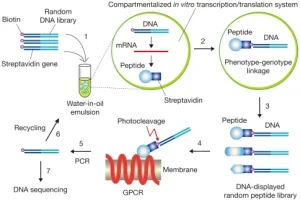
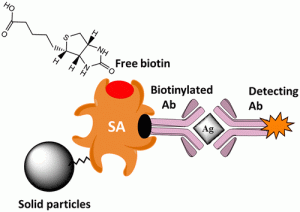
The streptavidin biotin interaction is non-covalent but nearly irreversible under physiological conditions. Because of this property, streptavidin is extensively used in applications such as affinity purification, ELISA systems, biosensors, molecular labeling, and in vivo imaging platforms where stable and specific molecular capture is required.
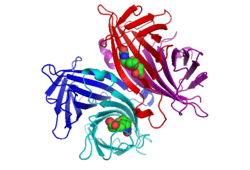
Structurally, streptavidin is composed of four identical subunits forming a stable homotetramer. Each monomer adopts an eight-stranded antiparallel β-barrel architecture. The biotin-binding pocket is located within the core of this β-barrel and is formed by residues from the same subunit together with contributions from a loop region of a neighboring subunit, contributing to its exceptional binding stability. The N-terminal region is exposed and does not directly participate in ligand binding.
Avidin, a functionally similar protein derived from chicken egg white, shares structural similarity with streptavidin and also binds biotin with high affinity. However, avidin differs in being glycosylated and positively charged, whereas streptavidin is non-glycosylated and neutral, which often makes streptavidin more suitable for biochemical and diagnostic applications due to reduced nonspecific interactions.
Recombinant streptavidin has been widely produced in Escherichia coli, either as a standalone protein or as a fusion partner with other functional domains such as single-chain antibodies or metallothionein. Numerous mutagenesis studies have been conducted to investigate residues involved in biotin affinity and oligomer assembly. However, in most traditional E. coli expression systems, streptavidin accumulates primarily as insoluble inclusion bodies, requiring complex refolding steps to obtain functional protein.
Although alternative expression platforms such as Bacillus subtilis and baculovirus-infected insect cells can produce soluble streptavidin, these systems are often more expensive or less scalable.
This study describes an optimized recombinant expression strategy that enables the production of soluble and functional streptavidin in E. coli by modifying the N-terminal sequence with a T7-tag peptide. The approach allows efficient soluble expression, simplified purification, and high-yield recovery of biologically active protein suitable for downstream biochemical and biotechnological applications.
The recombinant streptavidin can be purified using a simplified two-step process, achieving high purity and yields of approximately 70 mg per liter of bacterial culture. Functional assays, including ELISA and surface plasmon resonance (SPR), demonstrate that the recombinant protein retains binding characteristics comparable to native streptavidin.
Materials and Expression System
Gene Construct and Cloning Strategy
The DNA fragment encoding mature streptavidin (amino acids 14–159) was obtained and cloned into the pET11b bacterial expression vector. The construct was engineered to include:
- An N-terminal T7-tag fusion sequence
- Two additional residues (Asp–Gln) introduced during cloning
- The mature streptavidin coding sequence (residues 15–159)
The resulting recombinant gene encodes a 159-amino-acid fusion protein optimized for soluble expression in E. coli BL21(DE3).
Recombinant Protein Expression in E. coli
Transformed E. coli BL21(DE3) cells were cultivated in LB or TP rich medium under controlled fermentation conditions. Cultures were grown at either 25°C or 37°C until reaching mid-log phase (OD600 ≈ 0.8), followed by induction using IPTG (0.4 mM).
After induction, cells were incubated for additional expression time and harvested by centrifugation. Cell pellets were resuspended in Tris-based lysis buffer containing protease inhibitors and sodium azide, then disrupted by sonication under cold conditions.
Soluble and insoluble fractions were separated by centrifugation to evaluate protein solubility and optimize expression conditions.
Protein Purification Strategy
Heat Treatment and Affinity Chromatography
The soluble fraction of the bacterial lysate was subjected to controlled thermal treatment (75°C for 10 minutes), followed by rapid cooling and centrifugation. This heat step served as an initial purification step by denaturing many endogenous E. coli proteins while preserving thermostable streptavidin.
The clarified supernatant was then loaded onto a 2-iminobiotin agarose affinity column. After washing to remove non-specifically bound proteins, streptavidin was eluted under acidic conditions (pH 2.9) and immediately neutralized and dialyzed.
The purified protein was subsequently filtered, aliquoted, and stored at low temperature for long-term stability.
This streamlined purification workflow reduces processing complexity while maintaining high recovery efficiency and protein purity (>95%).
Analytical Characterization Methods
Molecular Weight and Oligomeric State
Protein mass was confirmed using electrospray ionization mass spectrometry, revealing a molecular mass consistent with the expected recombinant construct.
Gel filtration chromatography demonstrated that the protein forms stable tetramers, consistent with native streptavidin architecture.
Electrophoretic Analysis
Both SDS-PAGE and non-denaturing electrophoretic systems were used to evaluate purity and quaternary structure. The recombinant protein displayed expected molecular mobility and no evidence of subunit dissociation, confirming structural stability.
Functional Validation
Biotin Binding Assays (ELISA)
A competitive ELISA format was used to evaluate biotin-binding activity. Recombinant streptavidin showed binding performance comparable to native streptavidin, confirming that the N-terminal modification does not impair ligand affinity.
Surface Plasmon Resonance (SPR)
Binding kinetics were further analyzed using SPR technology. Streptavidin interaction with immobilized biotin analogs was used to determine:
- Association rate (kon)
- Dissociation rate (koff)
- Overall affinity constants (KA)
Results demonstrated that recombinant streptavidin exhibits kinetic parameters similar to native streptavidin and hen avidin, confirming preserved high-affinity biotin binding.
Findings and Discussion
This expression system demonstrates that soluble streptavidin can be efficiently produced in E. coli when engineered with an N-terminal T7-tag and optimized expression conditions. Unlike conventional systems where streptavidin forms insoluble inclusion bodies, this method yields a high proportion of soluble protein, eliminating the need for complex refolding steps.
Key advantages of the optimized system include:
- High-level soluble expression in E. coli
- Simplified two-step purification workflow
- High protein yield (~70 mg/L culture)
- Retention of native tetrameric structure
- Fully functional biotin-binding activity
The thermal stability of streptavidin plays a central role in enabling efficient purification via heat treatment, which removes most bacterial contaminants while preserving protein integrity.
Functional assays confirm that recombinant streptavidin retains biochemical properties comparable to the native protein, despite the addition of an N-terminal tag. Slight differences in specific activity are attributed to increased molecular mass rather than reduced binding efficiency.
Conclusion
This study presents an efficient and scalable recombinant expression system for producing soluble, stable, and fully functional streptavidin in Escherichia coli. The combination of N-terminal engineering and optimized expression conditions enables high-yield production with simplified downstream purification.
Due to its strong biotin-binding affinity, structural stability, and cost-effective production, this recombinant streptavidin system is highly suitable for large-scale applications in biotechnology, diagnostics, affinity purification systems, and molecular biology research workflows.