
Introduction
The TP53 gene is one of the most frequently mutated genes in human cancer, with mutation rates exceeding 50% in many tumor types, highlighting its central role as a key tumor suppressor gene. TP53 encodes the p53 protein, often referred to as the “guardian of the genome” due to its essential function in maintaining genomic stability through DNA binding and transcriptional regulation.
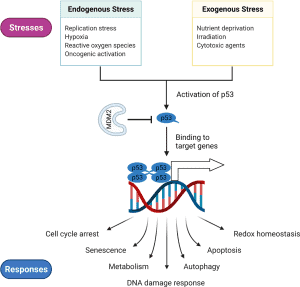
The p53 protein plays a critical role in cellular stress responses. It regulates:
- DNA damage repair pathways
- Cell cycle arrest mechanisms
- Apoptosis and programmed cell death
- Stem cell regulation and genomic integrity maintenance
Loss or alteration of TP53 function leads to uncontrolled cell proliferation and genomic instability, which are key drivers of tumor development.
TP53 in Hereditary and Sporadic Breast Cancer
The clinical importance of TP53 is clearly demonstrated in Li-Fraumeni syndrome, a hereditary cancer predisposition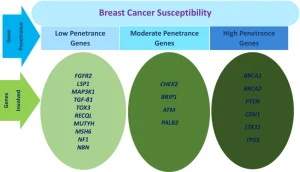 disorder caused by germline TP53 mutations. This syndrome is associated with early-onset and highly aggressive cancers, including:
- Breast cancer (~25%)
- Soft tissue and bone sarcomas (~35%)
- Brain tumors
In breast cancer specifically:
- Germline TP53 mutations are found in 5–8% of early-onset cases (<30 years old)
- Up to 85% of carriers may develop breast cancer during their lifetime
In sporadic breast cancer:
- Somatic TP53 mutations are present in approximately 37% of all cases
- Higher frequencies are observed in aggressive subtypes:
- HER2-positive tumors: ~72%
- Basal-like / triple-negative tumors: ~80%
These findings highlight the strong association between TP53 dysfunction and aggressive breast cancer biology.
Detection of TP53 Mutations
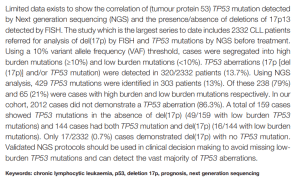
Traditionally, TP53 mutations were identified by sequencing hotspot regions, mainly exons 5–8, which contain the majority of known mutations. However, the development of next-generation sequencing (NGS) has significantly improved mutation detection by enabling:
- Genome-wide TP53 variant identification
- Detection of mutations outside classical hotspot regions
- Higher sensitivity and diagnostic accuracy
As a result, NGS is now considered a more comprehensive approach for TP53 mutation profiling in cancer research and clinical diagnostics.
Clinical Significance and Controversial Findings
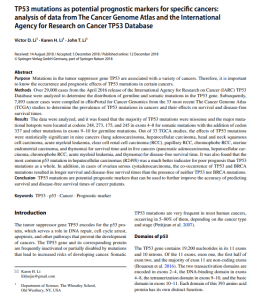
Multiple studies have investigated the prognostic role of TP53 mutations in breast cancer, but findings have been inconsistent across cohorts.
TP53 Mutation and Prognosis
Several reports suggest that TP53 mutations are associated with:
- Poor overall prognosis
- Increased mortality risk
- Reduced disease-free survival
- Aggressive tumor behavior
Early studies using immunohistochemistry (IHC) showed that p53 protein overexpression correlates with unfavorable outcomes in retrospective cohorts.
More recent sequencing-based studies confirmed that TP53 mutations are associated with:
- ER/PR-negative status
- Higher tumor grade
- Increased breast cancer-specific mortality
For example:
- TP53 mutations in exons 5–8 were linked to higher risk of cancer-specific death, independent of tumor size and lymph node status.
TP53 and Treatment Response
TP53 mutational status may also influence therapeutic response:
- In endocrine therapy–only patients, TP53 mutations were associated with worse survival (METABRIC analysis)
- In neoadjuvant chemotherapy cohorts, TP53 mutations were shown to predict treatment response variability
These findings suggest that TP53 status may function as both a prognostic and predictive biomarker depending on treatment context.
Study Objective
The aim of this study was to evaluate the prognostic significance of somatic TP53 mutations in patients with Stage I–III breast cancer treated at a single institution.
A case–control design was used to compare:
- Patients with TP53 somatic mutations (cases)
- TP53 wild-type patients (controls)
TP53 mutation detection was performed using next-generation sequencing (NGS) on formalin-fixed paraffin-embedded (FFPE) tumor tissues.
Results
Clinicopathological Characteristics
Clinical and pathological features including:
- Age at diagnosis
- Menopausal status
- Tumor subtype
- Histological grade
- ER/PR and HER2 expression
- Ki67 proliferation index
- TNM stage
- Treatment modalities
were analyzed in both groups.
No statistically significant differences were observed between cases and controls in terms of:
- Age at diagnosis
- Menopausal status
- Tumor stage
- Histological subtype
- Hormone receptor status
- HER2 status
- Tumor grade
- Ki67 index
Most TP53-mutated tumors exhibited:
- High-grade histology
- High proliferation index (Ki67 > 20%)
- Predominantly invasive ductal carcinoma
- Frequent hormone receptor positivity
- HER2 negativity in the majority of cases
TP53 Mutation Spectrum
The most frequently detected pathogenic TP53 mutations included:
- c.824G>A (p.Cys275Tyr)
- c.743G>A (p.Arg248Gln)
Other variants were detected at lower frequency, typically appearing in single cases.
Co-Occurring Genetic Alterations
Analysis of the broader tumor genomic landscape revealed additional mutations frequently co-existing with TP53 alterations.
Most common co-mutations:
- PIK3CA mutations (17.4% of TP53-mutant tumors)
- AKT1
- PTEN
- NRAS
Variants of Unknown Significance (VUS):
Frequently observed VUS included mutations in:
- ROS1 (most frequent)
- KMT2C
- NF1
- RET
- NOTCH1
These findings indicate a complex mutational background in TP53-mutated breast cancers.
Survival Analysis
Disease-free survival (DFS) analysis showed a strong association between TP53 mutation status and clinical outcome.
- TP53-mutated group: ~16.3 months DFS
- TP53 wild-type group: ~62.9 months DFS
This difference was statistically significant.
Kaplan–Meier analysis confirmed significantly reduced DFS in the TP53-mutant group.
Cox regression analysis demonstrated:
- Approximately 8-fold increased risk of recurrence in TP53-mutant patients
- Statistically significant association (p = 0.007)
Somatic TP53 mutations are strongly associated with poor prognosis in early-stage breast cancer, particularly reflected by reduced disease-free survival.
TP53 and Aggressive Tumor Biology
TP53-mutated tumors in this cohort were characterized by:
- High histological grade
- Increased proliferation (high Ki67)
- Aggressive clinical behavior
These findings are consistent with previous literature showing enrichment of TP53 mutations in:
- HER2-positive breast cancer
- Triple-negative breast cancer (TNBC)
Biological Mechanisms
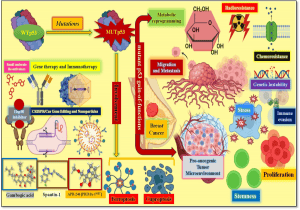
TP53 dysfunction contributes to tumor aggressiveness through multiple mechanisms:
- Disruption of epithelial-to-mesenchymal transition (EMT) regulation
- Altered miRNA signaling (e.g., miR-200c pathway)
- Activation of EMT transcription factors (Snail, Twist, ZEB2)
- Increased expression of invasion-related genes such as MMP1
- Enhanced metastatic potential and reduced differentiation
Overall, TP53 mutations promote a more invasive and stem-like tumor phenotype.
TP53 and PIK3CA Co-Mutation
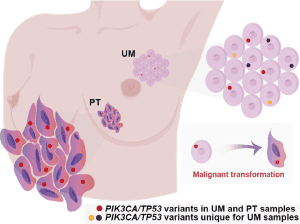
A notable finding was the co-occurrence of TP53 and PIK3CA mutations in approximately 17.4% of cases.
This is clinically relevant because:
- PIK3CA mutations are common in HR-positive tumors (~34.5%)
- Co-mutated TP53/PIK3CA tumors represent an aggressive molecular subgroup
- Previous studies suggest worse progression-free survival in dual-mutant tumors
This highlights the need for further research into combined mutational effects on treatment response and prognosis.
Comparison with Previous Studies
Our findings align with prior research showing that TP53 mutations are associated with:
- Poor clinical outcomes
- Subtype-specific prognostic effects
- Variable response to therapy depending on treatment type
Some studies suggest:
- Stronger prognostic impact in luminal B and HER2-positive tumors
- Limited impact in luminal A and basal-like subtypes
This supports the idea that TP53 function is context-dependent.
Strengths and Limitations
Strengths:
- Use of next-generation sequencing (NGS) for accurate mutation detection
- Matched case–control design
- Integration of clinical, pathological, and genomic data
NGS provides higher sensitivity than immunohistochemistry, especially for null mutations that may not produce detectable protein expression.
Limitations:
- Single-center retrospective design
- Relatively small sample size
- Need for validation in larger multicenter cohorts
Conclusion
Somatic TP53 mutations are strongly associated with reduced disease-free survival in early-stage breast cancer, confirming their role as an important prognostic biomarker.
In addition, TP53 mutations frequently co-exist with other oncogenic alterations such as PIK3CA, suggesting the presence of complex molecular subgroups with distinct clinical behavior.
Further large-scale, multicenter studies are required to better define the prognostic and predictive value of TP53 mutation status and its interaction with other genomic alterations in breast cancer.